How to Choose an AI Outbound Calling System: ROI Analysis of Automated vs. Human Outbound
Brandon Lu
COO
How many outbound calls does your sales team make every day? Whether it's insurance renewal reminders, appointment confirmations, property notifications, or satisfaction follow-ups, outbound calls are the lifeblood of many industries — and also the most labor-intensive work.
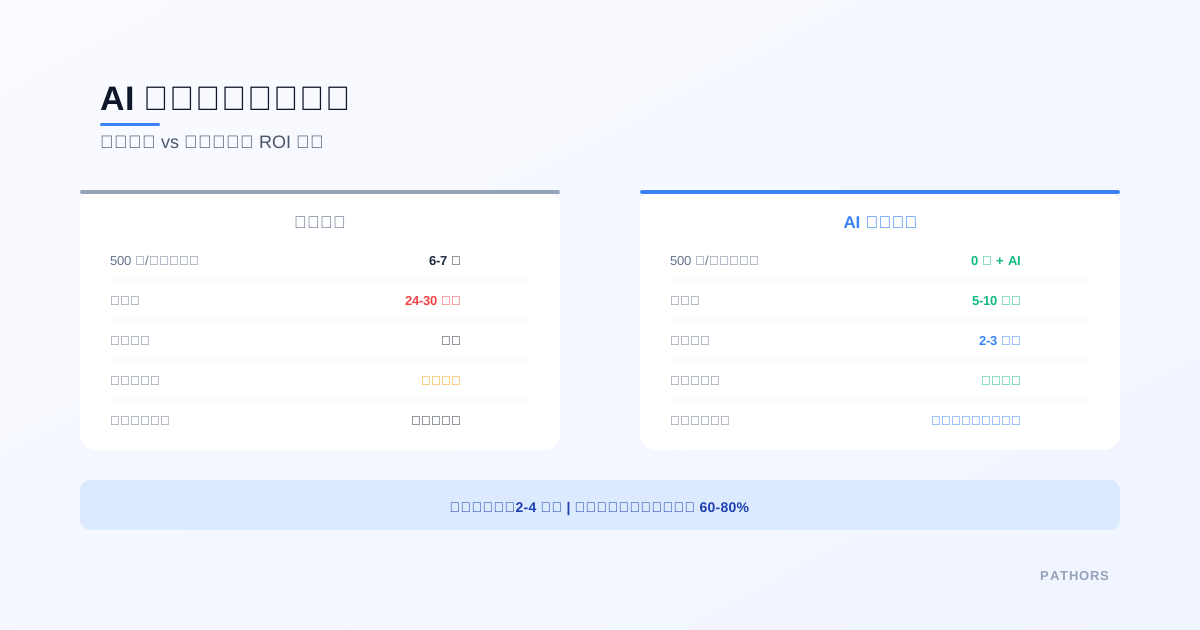
A sales rep can effectively make around 60–80 outbound calls per day (after accounting for no-answers, busy signals, and wrong numbers). If you have 500 outbound calls to make, that's 6–7 people spending their entire day on the phone. That time could be spent on higher-value activities — face-to-face client meetings, handling complex requirements, relationship building.
AI outbound calling systems rewrite this equation: the same 500 calls completed in a few hours, without fatigue, without emotional variability, with consistent quality on every call. But does that mean all outbound calling should go to AI? Not necessarily.
Automated vs. Human Outbound: Three Dimensions Compared
Dimension 1: Efficiency
AI automated outbound has an overwhelming speed advantage. AI can simultaneously run multiple outbound lines, without rest breaks, without idle time between attempts. 500 calls — AI completes them in 2–3 hours (including redials for no-answers). Human agents need 6–7 people a full day.
But efficiency isn't just speed. AI outbound's other efficiency advantage is precise control over calling windows. Based on historical data, AI automatically concentrates outbound calls during highest-answer-rate windows (typically 10–11 AM and 2–3 PM), avoiding low-answer-rate periods.
Dimension 2: Cost
A single outbound agent's monthly salary plus benefits, office space, and management overhead conservatively runs NTD 40,000–50,000 per month. Six agents means NTD 240,000–300,000 in monthly outbound labor cost.
AI outbound cost structure typically consists of: platform monthly fee + per-minute or per-call usage charges + telephone line fees. Based on market rates, handling the same 500 calls/day outbound volume, AI monthly fees typically run 1/3 to 1/5 of human labor costs.
Note: AI outbound has one-time build costs (conversation flow design, knowledge base build, integration development) that need to be factored into the ROI calculation. Typical payback period is 2–4 months.
Dimension 3: Call Quality
This is the most common concern. Will customers feel uncomfortable receiving an AI call? Will they immediately hang up? The answer depends on the nature of the outbound call.
Standardized notification outbound: AI quality ≥ human. Insurance renewal reminders, appointment confirmations, delivery notifications — these calls have clear purposes, brief conversations, and require no persuasion. AI performance typically matches or exceeds human agents; because the tone is consistent, information is accurate, and steps are never skipped, customer acceptance is generally solid.
Sales-driven outbound requiring persuasion: human > AI. Promoting new products, negotiating renewal terms, handling customer objections — these conversations require in-the-moment adaptation, emotional intelligence, and interpersonal trust. Current AI cannot match human agents in these scenarios.
Strategy: AI for first-round qualification, humans for closing. The smartest approach isn't binary. Have AI run the first round: confirm whether the prospect is interested, has time available, and what their basic needs are. Interested prospects are logged and scheduled for a human callback. Humans then only speak with customers who have already expressed interest — dramatically improving conversion rates per call.
ROI Calculation Example
Scenario: 10,000 insurance renewal reminder calls needed per month.
| Item | Human Outbound | AI Outbound |
|---|---|---|
| Headcount required | 8–10 agents | 0 (AI + 1 supervisor) |
| Monthly labor cost | NTD 400,000–500,000 | 0 |
| Platform monthly fee | 0 | NTD 30,000–80,000 |
| Call charges | ~NTD 20,000 | ~NTD 20,000 |
| Total monthly cost | NTD 420,000–520,000 | NTD 50,000–100,000 |
| Payback period | — | 1–2 months |
These numbers are estimates; actual figures vary by scenario and vendor. But the order-of-magnitude difference is clear: AI outbound has a very significant cost-efficiency advantage for standardized scenarios.
What to Evaluate When Choosing an AI Outbound System
Concurrent line capacity. What is your peak outbound volume? How many simultaneous lines can the system run? Insufficient concurrency means even a fast AI won't finish the job.
Redial strategy for no-answers. What happens when a customer doesn't pick up? How long until redial? How many maximum attempts? What time windows are used for redials? Good systems let you customize these rules.
Structured call result logging. Every call's outcome (confirmed / interested / declined / no-answer / requested callback) needs to be automatically recorded and exportable to your CRM or reporting system.
Compliance features. In Taiwan, AI outbound calls must disclose at the start of the call that the caller is an AI system and provide an opt-out option. Is this built into the platform?
Pathors' AI outbound calling feature supports multi-line concurrent outbound, customizable redial strategies, structured call result logging, and compliant disclosure mechanisms. Want to run an ROI calculation for your actual outbound scenario? Book a free Demo.

Brandon Lu
COO
Passionate about leveraging AI technology to transform customer service and business operations.
Ready to Transform Your Call Center?
Schedule a personalized demo and see how Pathors can revolutionize your customer service
Pathors empowers businesses with intelligent voice assistant solutions, streamlining customer service, appointment management, and business consulting to enhance operational efficiency.