AI Voice Cost ROI Framework: A Complete Guide Before You Buy

Brandon Lu

Brandon Lu

COO

AI Voice Cost ROI Framework: A Complete Guide Before You Buy

The moment you request a vendor quote for AI customer service, the pricing chaos begins. Per-minute billing. Per-seat licensing. Monthly SaaS fees. One-time implementation costs that show up after the contract is signed. If you don't walk in with your own framework, every number you receive is just noise.

We've built this ROI evaluation guide for operations and IT leaders who want to move beyond gut feeling and actually model the financial case for AI voice automation before committing budget.


Step 1: Calculate Your True Per-Call Cost

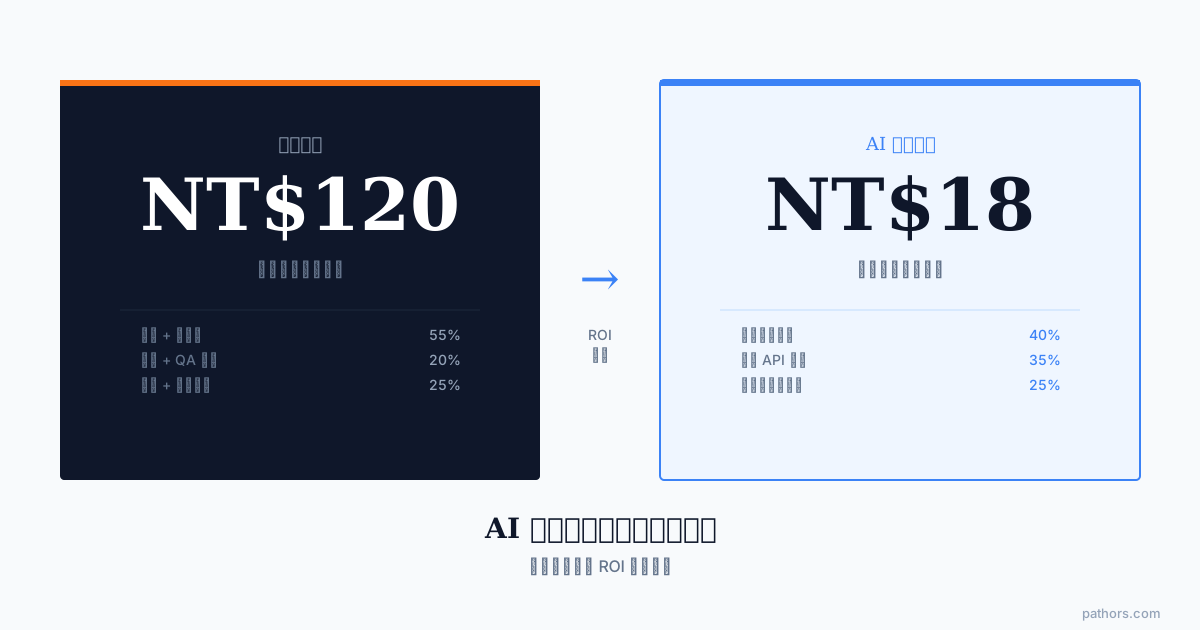
Most companies underestimate their current call-handling cost because they only count agent salaries. The real number includes everything that keeps a human on the phone:

  • Base salary + benefits: Health insurance, pension contributions — typically adds 20-25% on top of base
  • Management overhead: Supervisors, QA analysts, workforce management — budget another 15-20%
  • Training and ramp: New agents take 2-4 weeks before full productivity; high turnover multiplies this cost
  • Attrition cost: Contact center turnover in Taiwan often runs 20-40% annually; every departure carries a hidden recruitment and retraining cost
  • After-hours premium: Overtime rates for evening, weekend, and holiday coverage are frequently underbudgeted
  • Use this formula to establish your true cost per call:

    Cost per call = (Annual fully-loaded labor + systems + overhead) / Total annual calls handled

    When companies go through this exercise honestly, they typically land between NT$80–150 per call — meaningfully higher than their initial estimate.


    Step 2: Classify Your Call Volume by Automation Potential

    Not all calls are automatable. Not all automatable calls are worth automating. Before you can model ROI for voice AI, you need to segment your call volume:

    Tier 1 — Pure Information Requests (30-50% of volume)

  • Hours, locations, parking
  • Order status lookups
  • FAQ-style questions
  • Automation rate potential: 85%+

    Tier 2 — Conditional Transactions (20-35% of volume)

  • Appointment booking and cancellation
  • Account or profile updates
  • Triage and routing with context
  • Automation rate potential: 50-70%, requires system integration

    Tier 3 — Complex and Emotional Calls (15-30% of volume)

  • Complaints and escalations
  • Technical troubleshooting
  • High-value customer exceptions
  • Keep humans here. Don't automate it.

    Your ROI is almost entirely a function of Tier 1 and Tier 2 volume. Get this segmentation right and your financial model will hold up. Get it wrong and you'll be disappointed by results.


    Step 3: Build the ROI Model

    With your cost-per-call and volume segmentation in hand, you can run a first-pass ROI model:

    Savings Projection

    Automatable calls = Total annual calls × (Tier1% × 85% + Tier2% × 60%)
    Annual savings = Automatable calls × human cost-per-call

    AI Platform Cost Structure

    Most AI voice platforms charge across three buckets:

    1. Platform or seat license: Fixed monthly cost, often scaled by concurrent call capacity or conversation volume

    2. Implementation and integration: One-time charge for API connections, conversation flow design, testing, and go-live support

    3. Speech processing: Variable cost for ASR (speech-to-text) and TTS (text-to-speech), typically per-minute or per-character

    Breakeven Timeline

    Breakeven (months) = One-time implementation cost / (Monthly savings − Monthly platform fee)

    If this number exceeds 18 months, revisit your volume assumptions or vendor selection before signing.


    Step 4: Don't Ignore the Intangible ROI

    Cost savings are the easy part to quantify. These value drivers are harder to model but genuinely material:

    24/7 Service Coverage

    AI voice doesn't take nights or weekends off. In hospitality, healthcare, and e-commerce, a significant share of bookings and inquiries happen outside business hours. Every unanswered after-hours call is a potential customer lost to a competitor who picks up.

    Consistent Service Quality

    Human agents have good days and bad days. AI agents deliver the same experience on call one and call ten thousand. Brand consistency at scale is a real business asset.

    Structured Data as a Byproduct

    Every AI-handled call produces a structured interaction log. This data feeds directly into quality analysis, FAQ optimization, and eventually model improvement. Contrast this with human-handled calls, where insight is buried in CRM freetext fields that no one reads.


    Step 5: Demand Pricing Transparency from Vendors

    One pattern we've seen consistently in the market: initial quotes that look affordable become expensive after integration, volume overages, and support fees land on subsequent invoices.

    When evaluating any AI customer service platform, ask these questions before signing:

  • What's included in the quoted price? What triggers additional charges?
  • How does pricing scale as call volume grows?
  • Is there a cap on concurrent calls, and what happens if we exceed it?
  • What's included in implementation support vs. billed separately?
  • Are speech processing costs included, or billed through a third-party provider at pass-through rates?
  • Pathors provides all-inclusive pricing before contract signature — speech recognition, conversation engine, CRM integration, and implementation support are quoted together, not layered in over time. We also offer a paid PoC phase to validate automation rates against your real call data before you commit to full deployment. That PoC data becomes the foundation for your precise ROI model.


    Summary: Build Your Model Before You Talk to Vendors

    The right sequence for evaluating AI customer service costs:

    1. Calculate your true fully-loaded cost per call

    2. Segment your call volume into three automation tiers

    3. Build a breakeven timeline with realistic assumptions

    4. Identify intangible value drivers for your specific business

    5. Arrive at vendor conversations with your model in hand — then evaluate quotes against your numbers, not theirs

    If you'd like a customizable ROI template built around your call volume and cost structure, we're happy to run a 30-minute working session to build it with you.


    Brandon Lu

    Brandon Lu

    COO

    Passionate about leveraging AI technology to transform customer service and business operations.

    Read More Articles

    Ready to Transform Your Call Center?

    Schedule a personalized demo and see how Pathors can revolutionize your customer service

    🚀
    Pathors

    Pathors empowers businesses with intelligent voice assistant solutions, streamlining customer service, appointment management, and business consulting to enhance operational efficiency.

    02-7751-8783

    Resources

    Industries We Serve

    © 2026 Pathors Technology Co., Ltd. All rights reserved.
    派斯科技股份有限公司 | 統一編號:60410453