Auto Repair Shop AI Reminders: Reduce No-Shows and Boost Return Rates
Brandon Lu
COO
At the end of every week, a service advisor at an auto repair shop runs through the same manual exercise: pull up the upcoming appointment list, call each customer, remind them not to forget, deal with the ones who don't answer, and brace for the no-shows that will arrive anyway.
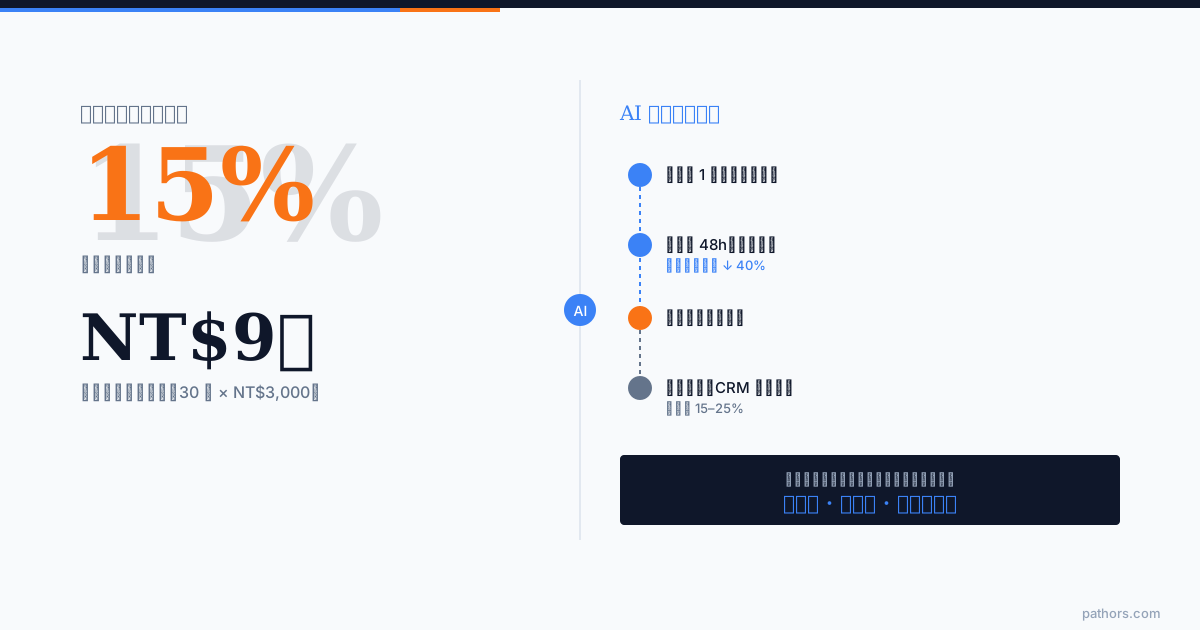
Industry no-show rates typically run 15–25%. The advisor who calls anyway still gets ghosted. The auto repair AI outbound approach isn't about calling harder — it's about converting reminder calls from an inconsistent manual task into a systematic, measurable process.
The Core Pain Points in Auto Repair Customer Service
No-Show Losses Are Larger Than Most Shop Owners Realize
A booked service slot represents 45 minutes to 1.5 hours of technician time. A no-show means:
At an average service value of NT$3,000 per visit, 30 monthly no-shows represent NT$90,000 in lost revenue potential. For authorized dealerships, this is absorbed as acceptable variance. For independent shops, it's a material burden.
Scheduled Return Visit Reminders Aren't Getting Done
Vehicles need service every 5,000–10,000 kilometers — roughly 2–4 times per year. That predictable return cycle is a repair shop's most stable revenue stream. The problem: customers don't keep track themselves.
Without proactive outreach, a customer who drove past a quick-service shop, got a recommendation from a friend, or simply couldn't remember where they last went — is gone. The shop that reminds them first, wins.
Service Progress Notifications Rely on Manual Calls
Once a vehicle is in the shop, several touchpoints require customer notification:
When these notifications depend on technicians or advisors manually calling between other work, they get delayed, missed, or inconsistently documented.
AI Outbound in the Auto Repair Shop Context
Application 1: Appointment Confirmation and Reminder
Immediate post-booking confirmation
Within 1 hour of scheduling, the AI calls to confirm appointment details — license plate, time, service items, and any special requests. This step substantially reduces "accidental bookings" that result in no-shows.
48-hour reminder
Two days before the appointment, the AI calls again and confirms attendance. For customers who confirm they're coming, no-show rates drop by 40%+ compared to unconfirmed appointments.
Day-before reminder
For high-demand slots or customers with a history of no-shows, a final reminder the day before — with a graceful rescheduling offer built in ("If something's come up, I can move you to next week — just let me know") — significantly reduces last-minute dropouts.
Application 2: Scheduled Return Visit Outbound
Every vehicle in the shop's CRM has a last service date and mileage record. From that data, the system can estimate each vehicle's next recommended service window:
Sample outbound script:
> "Hello, this is a service reminder from [Shop Name]. Your vehicle [license plate] was last serviced here about 3 months ago. Based on your service interval, now would be a good time for routine maintenance. Can I check our upcoming availability for you?"
The conversion rate from answered call to completed booking typically runs 15–25% — making this the highest-ROI CRM marketing action available to a repair shop.
Application 3: Service Status Notifications
Diagnosis complete notification
Once inspection is finished, the AI automatically calls: "Your vehicle inspection is complete. The recommended services include [items], estimated cost NT$[amount], estimated completion at [time]. Would you like to proceed?"
The customer confirms directly over the phone or requests a transfer to the technician. The response is automatically logged in the CRM.
Ready for pickup notification
When the vehicle is complete, the AI calls immediately. If unanswered, it auto-retries once after 30 minutes and logs the attempt.
Pathors Design Considerations for This Context
License plate identification: Mentioning the vehicle's license plate in the opening line instantly signals to the customer that this is a legitimate service call, not a sales call. This single detail dramatically improves post-answer engagement.
Automotive vocabulary tuning: Pathors' ASR model can be trained on automotive terminology — oil grades, brake components, suspension parts, transmission types, vehicle model names — ensuring accurate recognition when customers describe their vehicles and service needs.
Multi-location management: Chain repair shops can manage appointment and outbound tasks across multiple locations in the Pathors dashboard, with shared settings or location-specific script configurations.
Booking system integration: Pathors integrates with common repair shop management systems via API. Appointment data syncs bidirectionally — no manual re-entry.
Summary: AI Outbound Makes No-Show Rates Manageable
No-show rates in the auto repair industry have been accepted as a constant. They're not — they're a solvable problem. Consistent AI reminder execution, combined with proactive return visit outreach, is currently the most cost-effective customer management tool available to repair shops of any size.
If your shop is seeing more than 10 no-shows per month, or if your return visit ratio has been declining year over year, Pathors can deploy a complete automated reminder system within two weeks — and from the first month, the reduction in no-show losses will likely exceed the platform cost.

Brandon Lu
COO
Passionate about leveraging AI technology to transform customer service and business operations.
Ready to Transform Your Call Center?
Schedule a personalized demo and see how Pathors can revolutionize your customer service
Pathors empowers businesses with intelligent voice assistant solutions, streamlining customer service, appointment management, and business consulting to enhance operational efficiency.