Finance Industry AI Outbound Calls: Loan Reminders, Policy Renewals, and PDPA Compliance
Brandon Lu
COO
Financial institutions that want to deploy AI outbound calling face a dual challenge: demonstrating clear operational value while navigating a tightly regulated compliance environment. In Taiwan, any discussion of AI outbound that skips personal data protection law, financial consumer protection regulations, and do-not-call requirements is leaving the hardest problem for last.
This article addresses both dimensions together — because in financial services, compliance architecture and operational design cannot be sequenced; they need to be built simultaneously.
AI Outbound Use Cases in Financial Services
Financial institution outbound needs fall into three categories:
Category 1: Transaction and Account Notifications
This category carries the lowest compliance risk because it's grounded in an existing customer relationship and is service-oriented in nature:
The legal basis for this category is clean — these are service notifications within the scope of an existing banking relationship. Customer acceptance is highest in this category.
Category 2: Insurance Policy Reminders
Category 3: Promotional Outbound
This category has the highest compliance threshold. Taiwan's Personal Data Protection Act (PDPA) Article 20 requires that the use of personal data stay within the scope of the original collection purpose. If a customer provided data to open a checking account, and you're now calling to offer a personal loan, the alignment of those purposes requires advance legal review.
Additionally, do-not-call list compliance is mandatory — consumers can register to refuse marketing calls, and once registered, institutions are legally obligated to honor that preference.
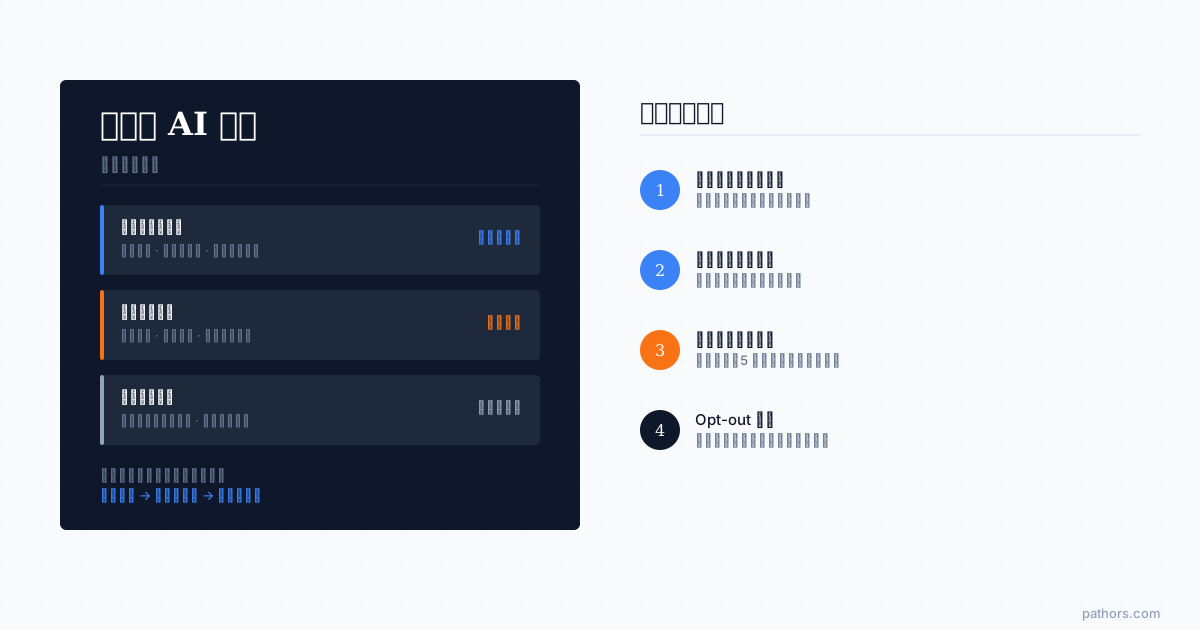
Four Compliance Design Requirements for Financial AI Outbound
Compliance in financial AI outbound cannot be retrofitted after deployment. It needs to be embedded at the architecture level.
Requirement 1: Collection Purpose Alignment Verification
Before any outbound campaign launches, the system must be able to answer: "Is the purpose of this outbound call within the scope of the data collection purpose that the customer was informed of when they provided their information?"
Implementation: Tag each customer's data record with collection purpose and consent scope in the CRM. Outbound campaign setup automatically cross-references these tags and excludes customers whose consent doesn't cover the campaign purpose.
Requirement 2: Real-Time Do-Not-Call List Synchronization
Government-maintained do-not-call registries and the institution's own customer opt-out list must synchronize with the outbound system in real time. Any number added to either list must be excluded before the next outbound execution window.
Recommended principle: "Blacklist-first" — query exclusion lists before executing any call, not after.
Requirement 3: Call Recording and Retention
Recording telephone conversations is a legal obligation for financial institutions under Taiwan's Financial Consumer Protection Act and related regulations. AI outbound calls are not exempt. Every call must be recorded with retention periods meeting regulatory requirements (typically 5 years).
AI-generated call recordings have a compliance advantage over manual recordings: they are structured, automatically tagged with call metadata, and more amenable to systematic compliance review.
Requirement 4: Opt-Out Mechanism in Every Call
Every AI outbound script must include a clear, easy path for customers to decline future calls:
> "If you'd prefer not to receive this type of reminder call, please say 'no thank you' or press 9, and we'll add your number to our do-not-contact list."
This isn't just compliance — it's brand protection. Making it easy to opt out preserves customer relationships better than forcing continued contact.
Voice Quality Requirements for Financial AI Outbound
Financial services AI outbound has higher voice quality standards than most industries:
Precision over fluency: Financial figures — loan balances, payment amounts, due dates — must be stated clearly with appropriate pauses. Large amounts should be confirmed verbally in a structured format ("fifty-two thousand, three hundred and forty New Taiwan Dollars") to prevent misunderstanding.
Error handling: If a customer's provided account number or confirmation doesn't match system records, the AI must clearly state that confirmation cannot proceed and offer immediate transfer to a human agent — not continue with a process that could later become a dispute.
Emotional context awareness: Loan overdue reminders require special handling. If a customer expresses emotional distress or raises difficulty making payment, the AI should immediately surface a transfer to a financial counselor option, rather than continuing the automated script.
Pathors Compliance Architecture for Financial Services
Pathors' voice AI platform includes compliance capabilities designed for regulated industries:
Consent-type tagging system: Customer records can be tagged with consent types. Outbound campaign configuration can target only customers with specific consent coverage, with automatic exclusion of others.
Bidirectional do-not-call synchronization: Integration with external do-not-call services and institution-maintained opt-out lists; real-time synchronization with automatic pre-call filtering.
Automated call recording and retention: Every outbound call recorded automatically with configurable retention periods; supports compliance audit and dispute resolution.
Emotional signal detection and escalation trigger: Voice sentiment analysis triggers human transfer option when elevated stress or negative emotion is detected in caller responses.
For financial institutions beginning their AI outbound journey, we recommend starting with notification-category outbound — repayment reminders, premium notices, account alerts — where the compliance basis is clean and ROI is directly measurable. This foundation builds the internal capability and confidence to expand into higher-value use cases.
Summary
Compliance in financial AI outbound is not a constraint on efficiency — it's the infrastructure that allows the capability to operate sustainably. Getting compliance design right means the system continues running. Getting it wrong means a customer complaint or regulatory inquiry forces you to shut it down.
Efficiency and compliance are not in tension. Starting with the right use cases and the right architecture is the fastest path to both.

Brandon Lu
COO
Passionate about leveraging AI technology to transform customer service and business operations.
Ready to Transform Your Call Center?
Schedule a personalized demo and see how Pathors can revolutionize your customer service
Pathors empowers businesses with intelligent voice assistant solutions, streamlining customer service, appointment management, and business consulting to enhance operational efficiency.