8 Questions You Must Ask Before Buying an AI Customer Service System
Brandon Lu
COO
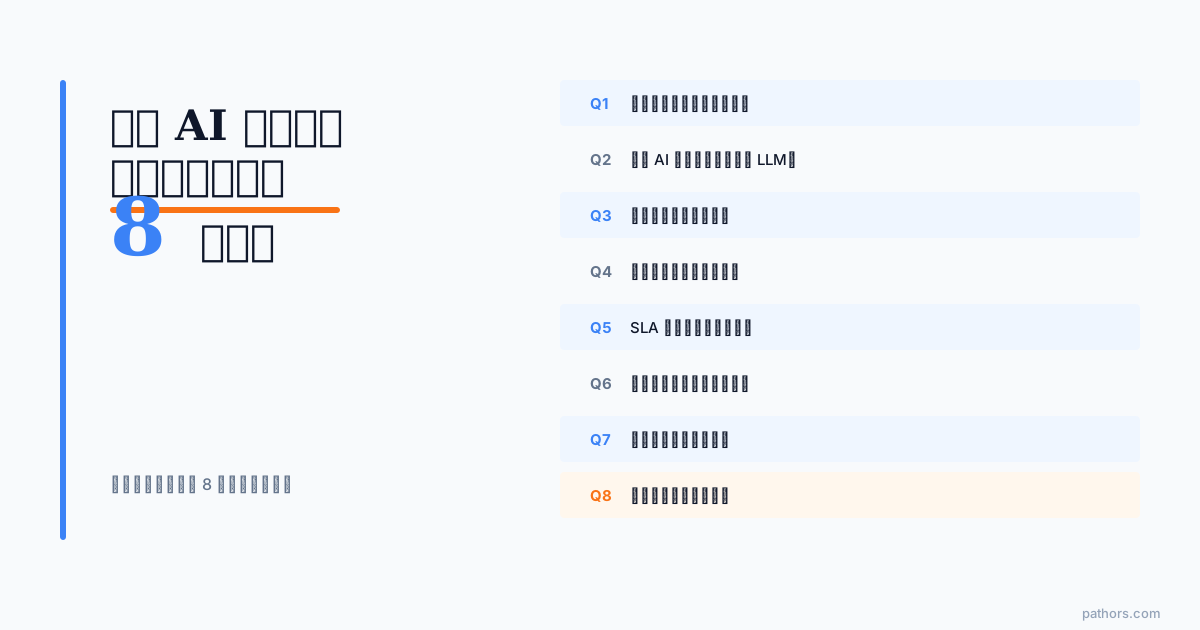
Most enterprise AI customer service procurement processes fail at the question stage. Companies spend meeting time asking "what's your accuracy rate?" and "does it integrate with LINE?" — and skip the questions that actually predict whether they'll be satisfied twelve months after go-live.
We've distilled years of vendor evaluation support into this eight-question checklist. Bring it to any vendor conversation and you'll surface answers that actually matter.
Q1: How Domain-Specific Is Your Speech Recognition Model?
This is the first and most important question.
General-purpose ASR models can perform well on everyday conversation. They perform considerably worse when your callers say things like "fractional laser," "picosecond," or specific drug names — if you're in aesthetics. Or vehicle model codes and service item names — if you're in automotive. Or account numbers and monetary amounts — if you're in finance.
Ask it this way: "Do you have domain vocabulary tuning for our industry, or do you have a mechanism to fine-tune the model on our actual call recordings?"
If the answer is "our model achieves 95% accuracy," follow up: "On what corpus? How representative is that of our call scenarios?"
Q2: What's the Architecture — Rule Engine or LLM?
There's no universally correct answer here. But the answer determines your future maintenance cost and operational flexibility.
Rule-based dialogue systems:
LLM-based dialogue AI:
Most modern platforms use a hybrid. What you want to understand is: "In our primary use cases, which parts are rule-driven and which are LLM-driven? What's the rationale for that division?"
Q3: Do You Own End-to-End Integration, or Do We?
This question determines your implementation timeline and hidden costs.
Some vendor quotes cover only the "AI platform" — backend system integration is a separate negotiation, often billed separately. If your booking system, CRM, or ERP doesn't have clean REST APIs, integration scope can balloon far beyond initial estimates.
Clarify:
Q4: Can Our Team Modify Conversation Flows Without a Vendor Engineer?
This determines your operational autonomy.
Some platforms require vendor engineering time to make any dialogue change — even updating a single FAQ answer. If your business runs seasonal promotions, temporary campaigns, or regularly changing policies, that dependency becomes a recurring operational drag.
Ask: "Do you have a no-code management interface where our customer service operations team can directly update conversation scripts? How quickly can we change a FAQ answer after go-live — without filing a support ticket?"
Pathors provides a management console designed for customer service managers — no engineering required to update conversation flows or knowledge base content.
Q5: What's Your SLA, and What Happens When the System Fails?
Your AI customer service system is the first touchpoint between your brand and your customers. If it goes down, calls go unanswered.
Verify:
A trustworthy vendor states SLA terms clearly. "Our system is very stable" is not an SLA.
Q6: Where Is Call Data Stored, and Are You Compliant with Taiwan's Personal Data Protection Act?
This question is especially critical for financial services, healthcare, and insurance industries.
Confirm:
Taiwan's Personal Data Protection Act requires clear legal basis for collecting, processing, and using personal data. Your AI platform's data handling must fit within that framework.
Q7: Can You Walk Me Through a Specific Deployment Case in Our Industry?
Don't settle for a customer logo list. What you want is evidence of problem-solving capability.
Ask it this way: "Can you describe a customer in a similar industry to ours — what specific challenge did they face, what did you do to address it, and what outcome did they achieve?"
If the vendor can only say "we have many large enterprise clients" but has no concrete problem-solution narrative, treat that answer skeptically.
Q8: How Does Pricing Scale When Our Business Grows?
Most companies don't think through pricing structure at growth inflection points during procurement.
Clarify:
Long-term pricing predictability is a material variable in your ROI model. If rates scale disproportionately with volume growth, your financial model needs recalculation before you sign.
Final Recommendation: Require a PoC, Not Just a Demo
Any vendor can build a compelling demo environment. What you actually need to see is their automation rate on your real call data.
Before making a final vendor decision, require a paid PoC from all shortlisted vendors — tested against your actual call samples. The investment is the cheapest insurance available against making an expensive wrong decision.
Pathors' PoC model is built on exactly this principle: demonstrate results on your real data before we discuss a long-term contract.

Brandon Lu
COO
Passionate about leveraging AI technology to transform customer service and business operations.
Ready to Transform Your Call Center?
Schedule a personalized demo and see how Pathors can revolutionize your customer service
Pathors empowers businesses with intelligent voice assistant solutions, streamlining customer service, appointment management, and business consulting to enhance operational efficiency.